THE ASHES OF SUBURBIA
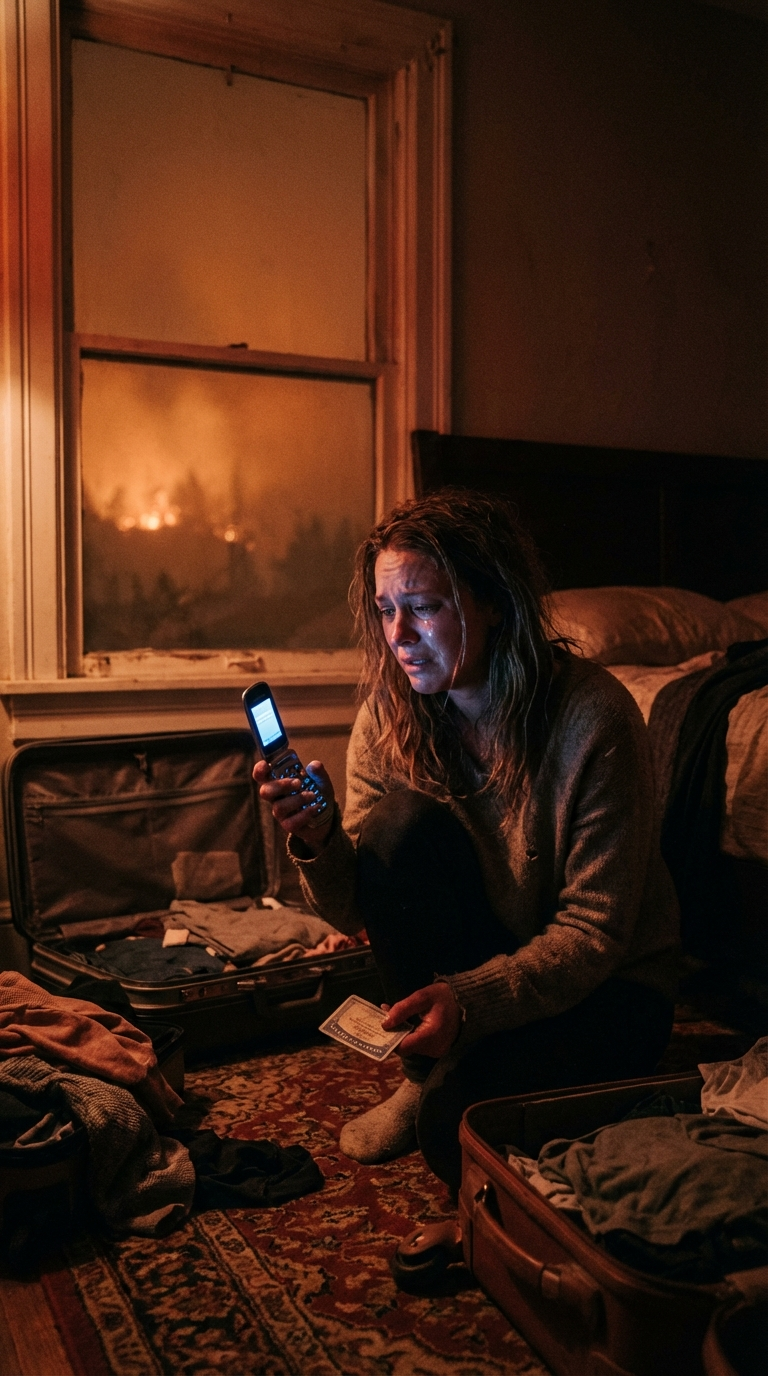
The air already tasted like copper and burnt pine needles. Outside the master bedroom window of our “forever home,” the suburban sky wasn’t black; it was a bruised, terrified orange. The eerie glow cast long, unsettling shadows across the room, turning familiar furniture into threatening shapes. The evacuation order had just come through our phones minutes ago, a screaming emergency alert that shattered the last facade of my perfect, carefully curated life.
“Sarah, grab the important documents! I’ll get the kids into the car! We have ten minutes, max!” Mark yelled from downstairs, his voice tight with a panic I naively thought was entirely about the encroaching wildfire that was consuming the hills above our affluent enclave.
I was frantic, moving on pure adrenaline, throwing passports, birth certificates, and insurance policies into a waterproof pouch. The smell of smoke was getting thicker, seeping through the expensive window seals. My hands were shaking so badly I dropped Mark’s social security card. It slid across the hardwood and disappeared under his heavy oak bedside table—the one he always instructed the cleaning lady never to move.
I got down on my hands and knees, coughing slightly from the acrid air, shoving my arm into the dark space to retrieve it. My fingers brushed against something cold and metallic that shouldn’t have been there. It was taped securely to the underside of the bottom drawer.
I froze. The roar of the wind outside, whipping the flames closer, seemed to dull. I peeled the object off.
A burner phone. A cheap, disposable flip phone, contrasting sharply with the latest iPhones we both carried.
Outside, sirens wailed, a mournful counterpoint to the sickening thudding of my own heart. I flipped the phone open. It was on, the battery fully charged. There was one new message notification on the tiny, pixelated screen, sent just three minutes ago.
The sender was listed only as “Escape Route.”
The message read: The fire is the perfect cover. Are you sure you can leave them behind tonight? The flight leaves in two hours. Don’t bottle it, Mark.
The floor seemed to tilt violently. The apocalyptic orange glow from outside pulsed against the bedroom walls like a dying heartbeat. Downstairs, I heard the front door slam and Mark shouting for Leo, our ten-year-old, to grab his shoes.
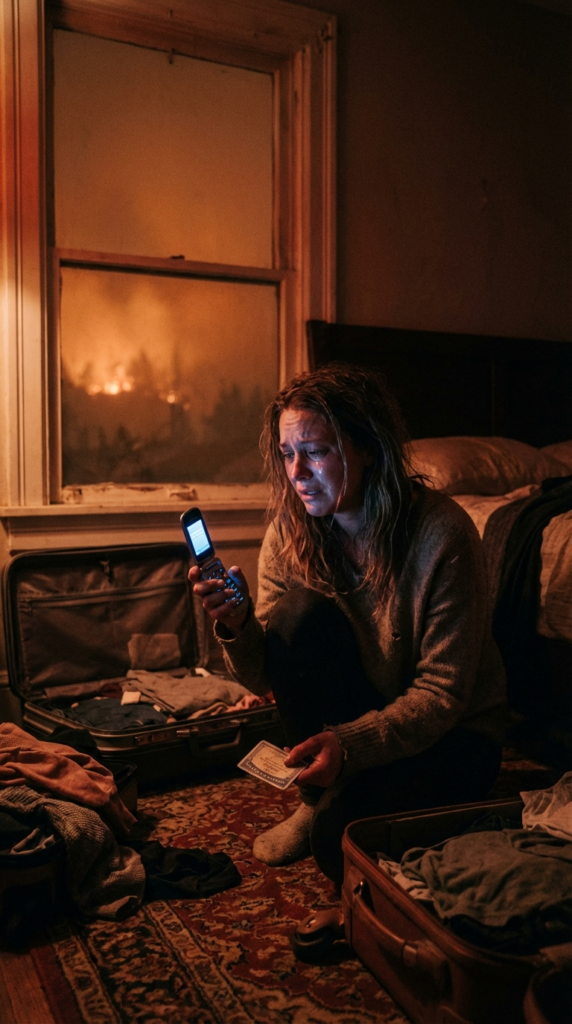
I sat back on my heels on the floor amidst the half-packed suitcases. I stared at that cheap plastic phone, its harsh blue light illuminating the tears of pure shock freezing on my face. In one hand, I held the identity of the man I’d been married to for twelve years—the father of my two beautiful children, the partner in my high-end real estate firm. In the other, I held the undeniable proof that I never really knew him at all.
He yelled my name from the bottom of the stairs, the practiced impatience now edging into his tone. “Sarah! Let’s go! What is taking so long?”
I couldn’t move. The realization hit me harder than the smoke. He wasn’t panicking about saving us from the fire. He was panicking about timing his exit.
THE GLASS HOUSE
To the outside world, Mark and Sarah were the golden couple of Oakhaven. We were the people on the Christmas cards you envied. Mark was the charismatic investment banker with the winning smile and the seemingly bottomless expense account. I was the top-tier realtor who managed to bake gluten-free cupcakes for the PTA bake sale while closing million-dollar deals.
We lived in a glass house, both literally and metaphorically. Our modern architectural marvel had floor-to-ceiling windows that offered stunning views of the canyon—the same canyon now ablaze. It was a life built on visibility, on showing everyone how successful we were.
But the glass was cracking long before the fire.
For the past three years, there had been a subtle erosion. It started with the late nights at the office. “Closing the Tokyo deal,” he’d say, smelling faintly of expensive scotch and an unfamiliar perfume that he claimed was just the office air freshener. When I questioned him, he’d turn it around on me with the ease of a seasoned litigator.
“You’re being paranoid, Sarah. You know how much pressure I’m under to provide this life for us,” he’d say, gesturing around our cavernous living room. “Instead of accusing me, maybe you could show a little gratitude.”
And I, desperate to keep the peace, desperate to believe in the fairy tale I’d bought into, would apologize. I’d shrink.
Then came the financial oddities. Our joint account, usually robust, started showing strange fluctuations. Large withdrawals were explained away as “short-term bridge investments” that were too complicated for me to understand. When I asked to see the statements, he became enraged, accusing me of not trusting his expertise.
“I handle the finances, you handle the home. That’s the deal, Sarah. Don’t break the deal.”
I was being gaslit so constantly that I needed a flashlight to find my own reality. I felt crazy. I felt ungrateful. I was the wife of a successful man, living in luxury, yet I felt constantly on edge, waiting for a shoe to drop. I just never imagined the shoe would be a wildfire, and the drop would be a burner phone hidden under a nightstand.
I had noticed him being particularly jumpy the last week. He was constantly checking his phone, snapping at the kids for minor infractions. When the news reports about the wildfires started, he seemed strangely fixated on them, tracking the wind direction with an intensity that seemed morbid.
Now I knew why. He wasn’t fearing the disaster; he was waiting for it. He needed chaos. He needed a smokescreen.
THE INFERNO
“Sarah, if you don’t come down right now, I’m taking the kids and leaving you!” Mark’s voice roared up the stairs, no longer trying to hide the cruelty.
The threat snapped me back to reality. The fire was real. My children were downstairs. I had to move.
I stood up, my legs feeling like lead. I shoved the burner phone into my bra. I finished grabbing the documents, my movements mechanical.
I walked down the grand staircase. The living room was bathed in that horrific orange light. Mark was by the front door, holding our six-year-old daughter, Lily, who was crying. Leo was standing by the door, clutching his backpack, looking terrified.
When Mark saw me, his eyes narrowed. He didn’t see a terrified wife; he saw an obstacle. “Where is the pouch? We have to go. The embers are already landing on the street.”
“I have it,” I said, my voice sounding strangely calm, almost detached.
We rushed out to the SUV. The heat outside hit us like a physical blow. Ash rained down like grey snow. The neighborhood was a scene of organized chaos—cars backing out of driveways, neighbors shouting farewells.
Mark drove aggressively, weaving through the traffic. The silence in the car was heavier than the smoke. The kids were whimpering in the back seat.
“It’s going to be okay, guys,” I said, turning to them, forcing a reassuring smile that felt like a lie on my face. “Daddy’s driving us to safety.”
Mark gripped the steering wheel so tightly his knuckles turned white. He kept checking his watch. He was sweating profusely, more than the heat warranted.
We finally made it past the police barricades and onto the highway, joining the river of red taillights fleeing the blaze. We drove for an hour in silence until we reached the designated evacuation center—a massive high school gymnasium two towns over.
It was chaos inside. Cots were set up in rows, Red Cross volunteers were handing out water and blankets. The air smelled of nervous sweat and residual smoke from people’s clothes.
We found a corner and sat the kids down on a cot. Mark was vibrating with nervous energy.
“I need to go make a call,” he said, not meeting my eyes. “Check on the… check on the insurance providers. Make sure we’re covered if the house goes.”
“Your phone has no signal in here, Mark,” I said quietly. “Mine doesn’t either.”
“I’ll go outside. I need fresh air anyway.” He turned to leave.
“Wait,” I said.
He stopped, impatient. “What now, Sarah?”
I stood up and walked over to him, close enough that he had to look at me. The gym lights were harsh fluorescent, unforgiving.
“Give me your keys,” I said.
“What? Why?”
“I left Lily’s inhaler in the car. I need to get it.”
He hesitated. For a split second, I saw genuine fear in his eyes. He patted his pockets. “I… I don’t know where I put them. I think I left them in the ignition.”
“You didn’t. You locked the car. I heard it beep.”
He stared at me, his jaw working. He knew something had shifted. The docile, apologetic Sarah was gone, replaced by someone he didn’t recognize in the fluorescent glare.
Reluctantly, he dug into his pocket and handed me the fob to our luxury SUV.
“Be quick,” he snapped. “I have to make this call.”
I walked out into the cooler night air of the parking lot. The orange glow was distant now, a horrific backdrop on the horizon. I went to our car, unlocked it, and sat in the driver’s seat.
I didn’t look for an inhaler. Lily didn’t even have asthma.
I opened the center console. Nothing. I checked the glove box. Just the manual. Then, I popped the trunk from the driver’s seat and climbed into the back.
Hidden in the spare tire well, beneath the carpeted floor of the trunk, was a black duffel bag I’d never seen before.
I unzipped it.
Inside were stacks of cash. Fifty-dollar bills, banded together. At least a hundred thousand dollars. Next to the cash were two passports. One was Mark’s, but the name was “Marcus Thorne.” The other belonged to a woman I recognized instantly—his twenty-four-year-old “executive assistant,” Chloe.
And beneath them, a one-way ticket to the Cayman Islands, departing tonight at 11:30 PM.
He wasn’t just leaving me. He was emptying us out and running off with his mistress, using the fire that was destroying our home as his distraction. He had probably started siphoning the money months ago, setting up this “Marcus Thorne” identity, waiting for the right moment to disappear while I was busy picking up the pieces of a disaster.
I sat there in the dark trunk of the car, the smell of rubber and betrayal filling my nose. I should have been devastated. I should have been hysterical.
Instead, a cold, hard clarity settled over me. The fear was gone, replaced by a volcanic rage that was hotter than the fire burning down our glass house.
I zipped up the bag. I took the burner phone out of my bra. I took a picture of the contents of the duffel bag—the cash, the fake passports, the tickets.
Then, I composed a text on my own phone. I attached the photo.
I didn’t send it to Mark.
I sent it to the Senior Partner at his investment firm. I sent it to the FBI tip line email address I quickly looked up. And finally, I sent it to Chloe, with a simple caption: He’s not coming. Enjoy your flight.
THE DAWN
I walked back into the gymnasium. Mark was standing by the doors, looking frantic, holding his regular phone up, trying to get a signal.
When he saw me, he rushed over. “Did you find it? The inhaler?”
I stopped in front of him. I looked him dead in the eyes. I let him see the change. I let him see the steel that had replaced the glass.
“No,” I said. “But I found ‘Marcus Thorne’.”
His face went grayish-white. His mouth opened, but no sound came out. The slick corporate mask slipped completely, revealing a pathetic, terrified little man.
“Sarah, wait, I can explain. It’s complicated, it’s a business arrangement…”
I held up the burner phone. “Does ‘Escape Route’ know you’re delayed?”
He reached for the phone, desperation in his eyes. I pulled it back.
“I already sent the pictures, Mark,” I said, my voice flat, devoid of any emotion he could manipulate. “To your boss. To the authorities. You’re done.”
He looked around wildly, as if expecting the police to burst through the gym doors right then. “You… you destroyed me,” he whispered, horrified.
“No, Mark,” I said, feeling a profound sense of release. “You set the fire. I just decided not to burn with you.”
I walked past him, back to the cot where my children were sleeping fitfully amidst the noise of hundreds of displaced families. I sat down between them, watching their chests rise and fall. We had lost our house tonight. We had lost the lifestyle we knew.
But as I sat there, listening to the distant sirens, I realized that for the first time in years, I wasn’t afraid of the future. The orange sky had burned away the lies. The glass house was gone, and I could finally breathe. We were starting from zero, but at least now, the ground beneath our feet was solid.